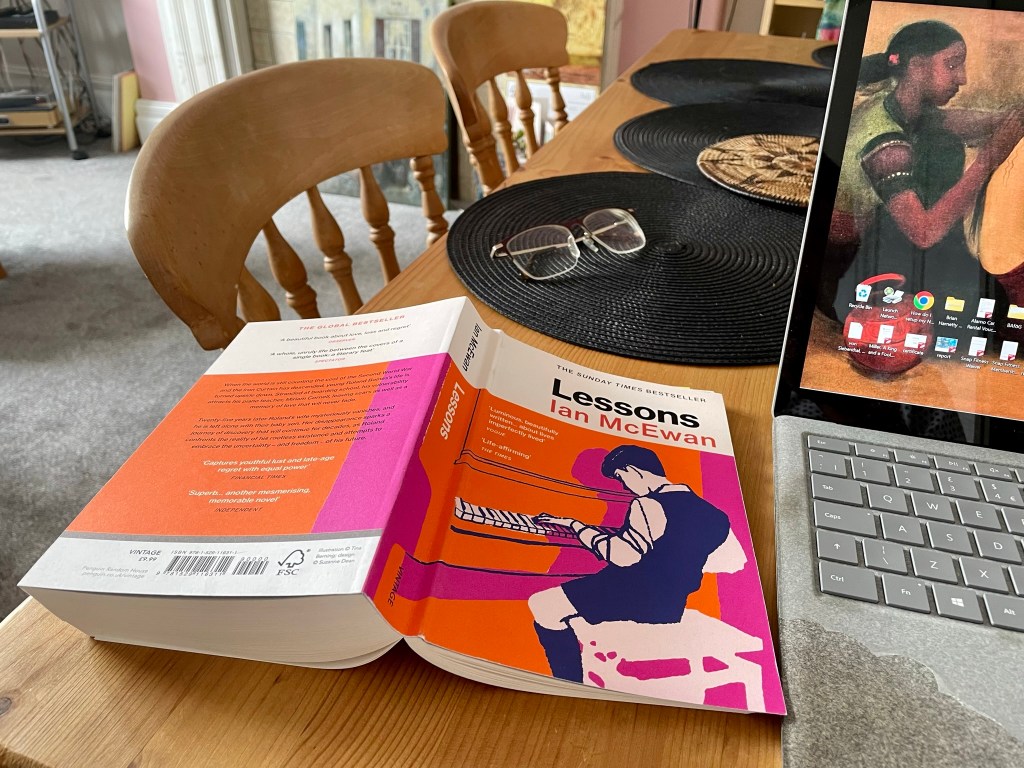
I’ve only read about 20% of Ian McEwan’s latest novel, but this promises to be another masterpiece. Among other things, it deals with the White Rose resistance group in Nazi Germany. In times when politicians once again widely abuse language to manipulate their electorate, it feels almost therapeutic to read about those brave, young intellectuals opposing Hitler in no uncertain terms. It’s a particular delight to read about all this in McEwan’s brilliant prose.
Here’s my final post offering thoughts from Krista Tippett’s book Becoming Wise.
I was struck by this wise statement on community by Dietrich Bonhoeffer, which she quotes:
The person who’s in love with their vision of community will destroy community. But the person who loves the people around them will create community wherever they go.
Brené Brown
Brené Brown, one of Tippett’s interviewees, studies vulnerability, courage, authenticity, and shame – and has this to say about courage and vulnerability:
I cannot find a single example of courage, moral courage, spiritual courage, leadership courage, relational courage, I cannot find a single example of courage that was not born completely of vulnerability. We buy into some mythology about vulnerability being weakness and being gullibility and being frailty because it gives us permission not to do it.
Even more powerfully, she makes the point that:
the most beautiful things I look back on in my life are coming out from underneath things I didn’t know I could get out from underneath.
Love is giving up control. It’s surrendering the desire to control the other person. The two – love and controlling power over the other person – are mutually exclusive. If we are serious about loving someone, we have to surrender all of the desires within us to manipulate the relationship.
Rob Bell, Sex God: Exploring the Endless Connections Between Sexuality and Spirituality
We cannot love God or our neighbour. We love both or neither. And what love means is rejoicing in the otherness of the other because the depth of this awareness is the depth of our communion with the other. … in the people we live with we find not objects to be cast in our own superficial likeness but, much more, we find in them our true selves, for our true selves only appear, only become realized, when we are wholly turned towards another.
[…]
In this recognition of the other person, a recognition that remakes my mind and expands my consciousness, the other person comes into being as they really are, in their real self, not as a manipulated extension of myself. People move and act out of their own integral reality and no longer as some image created by my imagination.
[…]
The essence of community … is a recognition of and deep reverence for the other.
Following up a friend’s recommendation, I am currently reading Barbara Glasson’s A Spirituality of Survival: Enabling a Response to Trauma and Abuse, a book that I am finding increasingly insightful, the more I am getting into it. Taking Miroslav Volf’s definition of exclusion from Exclusion and Embrace as her point of departure, Glasson rephrases this from the perspective of the victim, suggesting that:
… exclusion is being made invisible by someone who assumes superior power over us. We are rendered irrelevant and of no consequence. We are therefore pushed to the edges of … relationship to a place of silence, worthlessness and loneliness. … it can mean being owned or manipulated by someone who assumes power over us to such an extent that we lose any sense of autonomy.
Glasson describes this as ‘a double bind of silencing and isolation’, noting that victims are ‘simultaneously completely related to “the other” but also rendered totally irrelevant by “the other”.
Regardless of the motives of the abuser, a victim experiences this double bind of exclusion; this is why it renders them feeling unable to make easy changes. Whatever choice they make, they will be compounded in one cycle or another, of isolation or of ridicule, rendering them simultaneously more dependent and more isolated.
She adds:
In order to not be a victim of either oppression or invisibility … the structures of power [need to be reversed] in such a way that boundaries become liberating rather than controlling.
And she suggests:
The abused person is unable to unbind herself from the knot of victimization without the solidarity of others. These “others in solidarity” need to be prepared to enter into the bind and release it on behalf of the victim. Victims rarely move out of the cycles of abuse on their own but rather need the support, insight and understanding of those who “stand in solidarity”.
‘We either contemplate or we exploit.’ We either see things and persons with reverence and awe, and therefore treat them as genuinely other than ourselves; or we appropriate them, and manipulate them for our own purposes.
Thus Alan Jones, Soul Making: The Desert Way of Spirituality.


 Karl Möller