Of love, compassion and the unexpected angel of mercy

Without passion there’s no compassion. In the same way there has to be eros in the mixture if there is to be agape as well.

Thus open this morning’s ‘Lent Daily Reflections’ by the World Community for Christian Meditation. Both those sentences ring entirely true to me. It is through suffering that we learn to be compassionate; and true love is always marked by agape and eros.

The reflections then refer to Luke 22:41-44:

[Jesus] withdrew from them about a stone’s throw, knelt down, and prayed. He said, ‘Father, if it’s your will, take this cup of suffering away from me. However, not my will but your will must be done.’ Then a heavenly angel appeared to him and strengthened him. He was in anguish and prayed even more earnestly. His sweat became like drops of blood falling on the ground.

I have quoted this passage from the fairly new Common English Bible. Anyway, the reflections conclude:

This is no fairy tale. For any mature person it resonates with our own experience. Aloneness, anguish, fear, physical symptoms, the unexpected angel of mercy. But at the heart of it is the love [Jesus] felt holding him, which empowered him to love those he did not even, at that instant, consciously know.

There are two insights in this that resonate deeply with me: that we are empowered to love by being held in/by love ourselves, and that it is particularly in those experiences of intense suffering that we meet the unexpected angel of mercy.

We shall not call you human

Human beings come
from the same source.
We are one family.

If a part of the body hurts,
all parts contract with pain.

If you are not concerned
with another’s suffering,
we shall not call you human.

Saadi, as quoted by Coleman Barks in Rumi, Bridge to the Soul: Journeys Into the Music and Silence of the Heart

Brief but insightful spiritual reflections on the book of Jonah

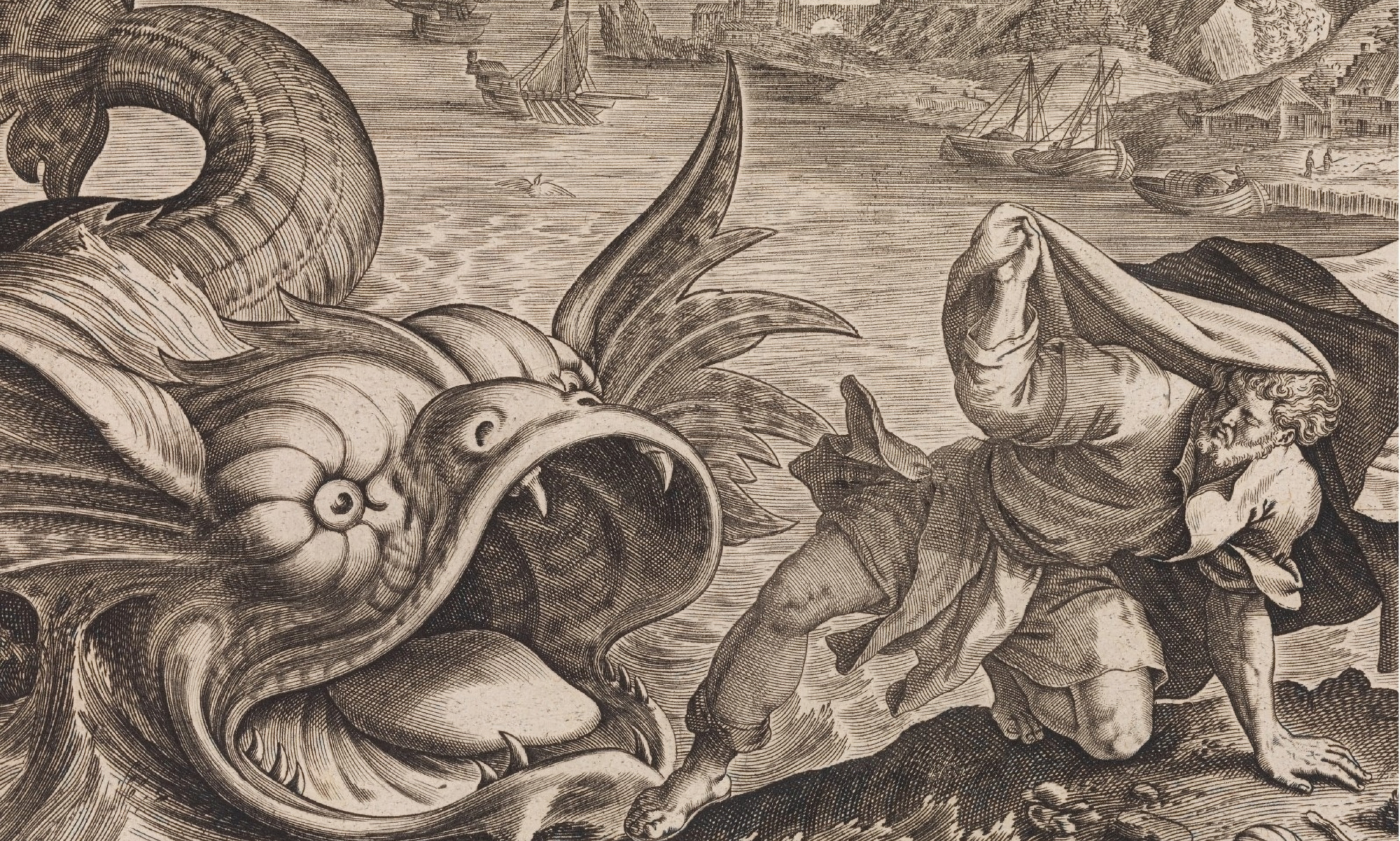
Paul Murray, A Journey with Jonah: The Spirituality of BewildermentPaul Murray’s book on the prophet Jonah, A Journey with Jonah: The Spirituality of Bewilderment, is a short one. Actually, it’s a very short one. Discounting the text of the book of Jonah itself and the illustrations, it runs to no more than 49 small pages. A pretty lightweight book then? Short, yes, but no, lightweight it isn’t. Although Murray, an Irish Dominican, obviously cannot give us an in-depth explanation of the text in those 49 pages, he has nonetheless written some quite remarkable reflections on this fascinating Old Testament text.

Murray is well-informed, and he manages, again rather surprisingly, given the limited space, to engage with an astonishing variety of perspectives, including modern scholarly treatments (Phyllis Trible, A. R. Ceresko, James Limburg, Yvonne Sherwood, André LaCocque, Jack Sasson, Hans Walter Wolff), works from the long history of Christian and Jewish engagement with this text (Jerome, Augustine, Methodius, Columban, Martin Luther, Rabbi Eliezer, the Zoar), poets, novelists and dramatists (Herman Melville, Francis Quarles, Wolf Mankowitz, Hart Crane, Robert Frost), philosophers and psychologists (George Steiner, Erich Fromm, Carl Gustav Jung, Martin Buber), mystics (John of the Cross, Teresa of Avila, Thomas Merton), the list goes on ….

More importantly, in his brief comments on the lesson of the wild storm, the lesson of the great whale (before anyone objects, Murray is well aware that the Hebrew text doesn’t mention a whale) and the lesson of the wondrous plant, Murray has given us some equally brief but nonetheless insightful spiritual reflections on fear, terror and courage; compassion, love and responsibility; suffering and bewilderment; failure and breakdown; death and resurrection; anger, resentment and bigotry ….

The following quotes may give a flavour of Murray’s writing:

… the moment of actual failure and breakdown – the experience of bewilderment in our lives – can be the moment of breakthrough, the moment when God’s grace finally shakes down all our defences. And then, to our amazement, from out of the belly of failure, from out of the death of false dreams and false ideals, and even from the jaws of a living hell, we can begin to experience the grace of resurrection.

… sometimes, it is only in the midst of the ‘tempest’, in the heart of a storm of circumstances which we can’t control, that we come finally to realise something of the wonderful mystery of God, and realise also how far beyond anything we can imagine or hope for are his plans both for ourselves and for the entire world.

Here’s something else that Murray has done for me. Having come across numerous references to John of the Cross’s reflections on the ‘dark night of the soul’ in recent months, Murray’s quotes from this text have finally persuaded me that I must go and read it!