As Ian Adams points out, in Cave, Refectory, Road: Monastic Rhythms for Contemporary Living:
In the religious communities that I know, sandals with socks are more than fine.
Yay!
‘I wonder sometimes if the teacher is not the real student and beneficiary’ (George Steiner)
As Ian Adams points out, in Cave, Refectory, Road: Monastic Rhythms for Contemporary Living:
In the religious communities that I know, sandals with socks are more than fine.
Yay!
To be a follower of Jesus … means … to see through every regime that promises peace through violence, peace through domination, peace through genocide, peace through exclusion and intimidation. Following Jesus … means forming communion that seeks peace through justice, generosity, and mutual concern, a willingness to suffer persecution but a refusal to inflict it on others.
Brian D. McLaren, Everything Must Change: Jesus, Global Crises, and a Revolution of Hope
 Some quotes from Desmond Tutu’s God Has a Dream: A Vision of Hope for Our Time.
On ‘a deep reverence’ for this world:
… all is ultimately holy ground and we should figuratively take off our shoes for it all has the potential to be ‘theophanic’ – to reveal the divine. Every shrub has the ability to be a burning bush and to offer us an encounter with the transcendent.
On a church that is too focused on the world to come:
A church that tries to pacify us, telling us not to concentrate on the things of this world but of the other, the next world, needs to be treated with withering scorn and contempt as being not only wholly irrelevant but actually blasphemous.
On prayer, government and the kingdom of God:
It is dangerous to pray, for an authentic spirituality is subversive of injustice. Oppressive and unjust governments should stop people from praying to God, should stop them from reading and meditating on the Bible, for these activities will constrain them to work for the establishment of God’s kingdom of justice, of peace, of laughter, of joy, of caring, of sharing, of reconciliation, of compassion.
On peace, justice and terrorism:
… instability and despair in the third world lead to terrorism and instability in the first world. … there is no way in which we can win the war against terrorism as long as there are conditions that make people desperate. […] there is no peace without justice, and safety only comes when desperation ends.
Wise words!
I came across this amazing sculpture entitled Homeless Jesus in the April issue of Third Way.

Apparently, it has been installed with a plague featuring words from Matthew 25:40:
Truly, I say to you, as you did it to one of the least of these my brothers, you did it to me.
What this picture doesn’t show is that the artist Timothy Schmalz (shown below) left room for one person to sit next to Homeless Jesus.
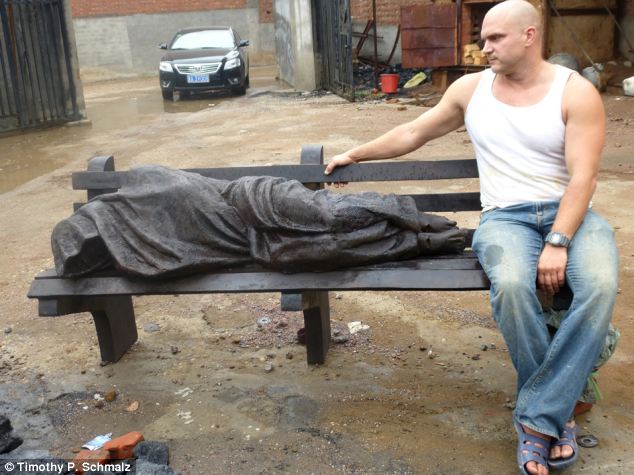
I have since discovered the following pictures of the sculpture in the rain and snow, which make it even more poignant.


It appears that the sculpture had to be moved from its original location because of objections by residents. One such objection is quoted in Third Way:
My complaint is not about the art-worthiness or the meaning behind the sculpture. It is about people driving into our beautiful, reasonably upscale neighborhood and seeing an ugly homeless person sleeping on a park bench.
Hmm, there’s a lesson in there somewhere …
These thoughts by Elisabeth Pike on beauty and writing resonated with me. They’re from an article entitled ‘Space to create’, which appeared in Third Way, April 2014.
I have heard it said that writing is as much about staring at the empty page as it is about writing. I love that. It takes the pressure off; it gives permission to dream. As Nabokov said in Lectures on Literature, the words will arrive when they are ready: ‘the pages are still blank, but there is a miraculous feeling of the words being there, written in invisible ink and clamouring to become visible.’
Pike then quotes some lines from Virginia Woolf’s In a Room of One’s Own on idling and comments:
To idle! Did you hear that? There is always beauty to be found, whether we are at home looking after toddlers, or paying the rent with a day job.
And again:
The beauty is always there … you just have to take the time, open your eyes and perceive it.
And she quotes from Raymond Carver’s essay ‘On Writing’, published in Fires:
A writer sometimes needs to be able to stand and gape at this or that thing – a sunset or an old shoe – in absolute and simple amazement.
This, as Pike concludes, is what it’s about:
To live, to see, to idle, to communicate wonder!
.
It is forbidden to kill. All murderers are punished unless they kill in large numbers and to the sound of trumpets.
Voltaire, as quoted by Catherine von Ruhland in Third Way, Jan./Feb. 2014
 Karl Möller