The challenge

If we do not transform our pain, we will most assuredly transmit it.

This is one of the statements that I most associate with Richard Rohr; and it is one that he must have said dozens of times. And so it also appears in Things Hidden: Scripture as Spirituality, where he adds:

If we cannot find a way to make our wounds into sacred wounds, we invariably become negative or bitter. Indeed, there are bitter people everywhere, inside and outside of the church. As they go through life, the hurts, disappointments, betrayals, abandonments, the burden of their own sinfulness and brokenness all pile up, and they do not know where to put it.

If there isn’t some way to find some deeper meaning to our suffering, to find that God is somehow in it, and can even use it for good, we will normally close up and close down. The natural movement of the ego is to protect itself so as not to be hurt again.

Biblical revelation is about transforming history and individuals so that we don’t just keep handing the pain onto the next generation. … Exporting our unresolved hurt is almost the underlying story line of human history, so you see why people still need healthy spirituality and healthy religion.

I think Rohr is right. How we deal with our hurts, disappointments, betrayals etc. makes all the difference, not only in how we experience and treat others, but also in how we experience life itself. Bitterness, cynicism and distrust are so dangerous because they are so destructive. They can seriously hurt and even destroy others, but that’s not all: in the end, they can destroy us, too.

The challenge, then, is not to close down but to accept and integrate our hurts, disappointments and betrayals, which of course hurt the more the less expected they are. The challenge is to transform our pain and not transmit it, to let ourselves be hurt without hitting back. A true challenge indeed, but the realisation that this is the only healthy way forward is perhaps the first step. Compassion for those who hurt us and a commitment to non-violence in all walks of life make all the difference, for ourselves in the first place but also, in the long run, for those we encounter.

Secret places inside this violent world

Time for some more of Rumi’s poetry, again in the translation of Coleman Barks, from Bridge to the Soul: Journeys into the Music and Silence of the Heart.

I am sure I have said this before, but Rumi has been an amazing discovery for me. There is profound spiritual insight in the words of this Sufi master, and there is so much here that speaks to me at such a deep level. Some of it puts into words my own recent journey in ways that I could never have managed myself. Other parts express some of my deepest hopes and longings. And then there are many wonderful insights about God, love, friendship etc.

If only more people would read Rumi’s poetry. It would open their eyes to quite a different side of Islam. But then, he apparently is the most widely read poet in America today. There is still hope then …

We must die to become true human beings.

From gardens to the gardener,
from grieving to a wedding feast.

We tremble like leaves about to let go.
There is no avoiding pain,
or feeling exiled, or the taste of dust.

I can truly relate to those reflections on dying, grieving, letting go, experiencing pain and the taste of dust.

When someone feels jealous,
I am inside the hurt and the need to possess.

When anyone is sick,
I feel feverish and dizzy.

This I find comforting: that God is inside the hurt of those who need to possess others. And that he is inside our sickness.

For the grace of the presence, be grateful.

Imagination cannot contain the absolute.
These poems are elusive
because the presence is.

‘Imagination cannot contain the absolute’. Quite. No point to even try!

No more holding back. Be reckless.
Tell your love to everybody.


Stand up. The prostrating
part of prayer is over.

the beloved is absence
as well as this fullness.

I love that attitude to praying and loving God.

Be a helpful friend,
and you will become a green tree
with always new fruit,
always deeper journeys into love.

Worth aspiring to …

Learned theologians do not teach love.
Love is nothing but gladness and kindness.

When you see a scowling face,
it is not a lover’s.

Rumi really does understand true love.

Lovers find secret places
inside this violent world
where they make transactions
with beauty.

Reason says, Nonsense.
I have walked and measured the walls here.
There are no places like that.

Love says, There are.

Lovers feel a truth inside themselves
that rational people keep denying.

This is just brilliant stuff, so true and so well expressed. Secret places in a violent world where you make transactions with beauty – that’s truly wonderful and how I wish to live.

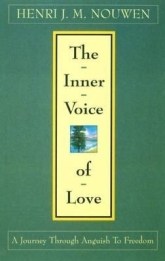
Best Reads 2013. VIII: Henri J. M. Nouwen, The Inner Voice of Love: A Journey through Anguish to Freedom

Henri J. M. Nouwen, The Inner Voice of LoveThis is one of the lesser known books by the late Dutch Roman Catholic priest Henri Nouwen, best remembered perhaps for books such as The Return of the Prodigal Son and The Wounded Healer. In the former, he briefly talks about giving up his distinguished academic career in order to work with people with mental disabilities at the L’Arche Daybreak Community in Toronto. In The Inner Voice of Love, Nouwen reveals that, during his time at L’Arche, he suffered a severe breakdown lasting about six months, a period he describes as the most difficult time of his life. It was, he says, ‘a time of extreme anguish, during which I wondered whether I would be able to hold on to my life’.

I felt that God had abandoned me. … The anguish completely paralysed me. I could no longer sleep. I cried uncontrollably for hours. I could not be reached by consoling words or arguments. I no longer had any interest in other people’s problems. I lost all appetite for food and could not appreciate the beauty of music, art, or even nature. All had become darkness. Within me there was one long scream coming from a place I didn’t know existed, a place full of demons.

The breakdown was triggered by the loss of a close friendship, which Nouwen describes in moving terms:

Going to L’Arche and living with very vulnerable people, I had gradually let go of many of my inner guards and opened my heart more fully to others. Among my many friends, one had been able to touch me in a way I had never been touched before. Our friendship encouraged me to allow myself to be loved and cared for with greater trust and confidence. It was a totally new experience for me, and it brought immense joy and peace. It seemed as if a door of my interior life had been opened, a door that had remained locked during my youth and most of my adult life.

When that friendship came to an end, Nouwen ‘lived through an agony that never seemed to end’. But, he says, he never lost the ability to write. Indeed, writing became part of his ‘struggle for survival’, and so he kept a secret journal, which was to be published years later as The Inner Voice of Love.

In this book, Nouwen describes how the loss of that friendship ultimately deepened his love of God, and how his suffering taught him compassion for others. There are many profound insights in these reflections on issues such as wounds and pain, friendship, love and compassion, God and spirituality, loneliness and transformation, the body, emotions and incarnation, community and living up to one’s calling.

The following quotes, offered without further comment and presented simply in the order in which they appear, give an illustration of the richness of Nouwen’s thought:

… those who seem to reject you … never speak about you. They speak about their own limitations. … They simply ask for your compassion.

Your willingness to let go of your desire to control your life reveals a certain trust. The more you relinquish your stubborn need to maintain power, the more you will get in touch with the One who has the power to heal and guide you. … As long as you run from where you are and distract yourself, you cannot fully let yourself be healed.

It is important that you dare to stay with your pain and allow it to be there.

When your deepest self is connected with the deepest self of another, that person’s absence may be painful, but it will lead you to a profound communion with the person, because loving each other is loving in God. When the place where God dwells in you is intimately connected with the place where God dwells in the other, the absence of the other person is not destructive. On the contrary, it will challenge you to enter more deeply into communion with God, the source of all unity and communion among people.

There is a real pain in your heart, a pain that truly belongs to you. You know now that you cannot avoid, ignore, or repress it. It is this pain that reveals to you how you are called to live in solidarity with the broken human race.

… real healing comes from realising that your own particular pain is a share in humanity’s pain. That realisation allows you to forgive your enemies and enter into a truly compassionate life.

The great challenge is living your wounds through instead of thinking them through. It is better to cry than to worry, better to feel your wounds deeply than to understand them …

It is you who decides what you think, say, and do. You can think yourself into a depression, you can talk yourself into low self-esteem, you can act in a self-rejecting way. But you always have a choice to think, speak, and act in the name of God and so move towards the Light, the Truth, and the Life.

There is much in this book, which I discovered quite by chance and only recently, that I can relate to in deep and profound ways. Nouwen’s journey from anguish to freedom is also one from hurt and pain to love and compassion, and that goal of a loving and compassionate life, while not making the hurt and pain any easier to endure, can give deep meaning to our struggles.

Under the seams runs the pain

Geryon struggles on in Anne Carson’s Autobiography of Red, grieving for the devastating loss of a lover. But we also learn about other aspects of his life. Like Carson herself (there are strong autobiographical references in this story), he is a linguist. And so, sat in a café in Buenos Aires, ‘he rummaged inside himself for Spanish phrases’. Yet what he found was that

German irregular verbs
were marching across his mind as the waiter drew up at his table and stood …

Two key issues that pervade the narrative are Geryon’s difficulties with self-acceptance (being red and endowed with wings, he is noticeably different from everyone else) and how he is perceived by others. Thus there is

the fear of ridicule,
to which everyday life as a winged red person had accommodated Geryon early in life …

as well as this telling dialogue with a woman he met in a bar:

Who can a monster blame for being red?
What? said Geryon starting forward.
I said looks like time for you to get home to bed, she repeated, and stood,
pocketing her cigarettes.

One of his endearing character traits is a desperate need for order. As he enters a lecture room, we are told:

Geryon disliked a room without rows.
His brain went running back and forth over the disorder of desks trying to see
straight lines. Each time finding
an odd number it jammed then restarted.

On another occasion, he struggles when someone he has enjoyed a good conversation with leaves the bar, abandoning him to the company of virtual strangers.

Oh don’t go, thought Geryon who felt himself starting
to slide off the surface of the room
like an olive off a plate. When the plate attained an angle of thirty degrees
he would vanish into his own blankness.

And so:

Geryon subsided into his overcoat
letting the talk flow over him warm as a bath.

Once more, I am finding myself amazed at how well Carson captures the panic an introvert might face in a situation like that.

But loss and grief remain his main problems. In a conversation with another stranger the issue of emotionlessness or artaraxia comes up, which Geryon defines as ‘absence of disturbance’ but which so evidently eludes him. Whatever he does,

Under the seams runs the pain.

In his desire to come to terms with his struggle and life generally, he eventually takes up philosophy:

We would think ourselves continuous with the world if we did not have moods.
It is state-of-mind that discloses to us
(Heidegger claims) that we are beings who have been thrown into something else.
Something else than what?
Geryon leaned his hot forehead against the filthy windowpane and wept.
Something else than this hotel room

Geryon sat on his bed in the hotel room pondering the cracks and fissures
of his inner life. …

Yet Geryon did not want
to become one of those people
who think of nothing but their stores of pain. He bent over the book on his knees.
Philosophic Problems.
‘… I will never know how you see red and you will never know how I see it.
But this separation of consciousness
is recognized only after a failure of communication, and our first movement is
to believe in an undivided being between us ….’

Carson so brilliantly exposes the autobiographical dimension that inheres in our work and study. Geryon, for obvious reasons, is particularly intrigued by the notion of redness. More generally though he is concerned with perception (how we perceive ourselves and are perceived by others), consciousness and the impossibility of communication.

His reading also leads him to explore the nature of depression:

‘Depression is one of the unknown modes of being.
There are no words for a world without a self, seen with impersonal clarity.
All language can register is the slow return
to oblivion we call health when imagination automatically recolors the landscape
and habit blurs perception and language
takes up its routine flourishes.’ He was about to turn the page for more help …

Yet again, Carson offers such an intriguing perspective in these lines. There are quite a few fascinating angles here, but I particularly love the final words, ‘he was about to turn the page for more help’.

And then the inevitable happens …

Best Reads 2013. VII: Anne Carson, Red Doc>

Anne Carson, Red Doc>Anne Carson. Red Doc>. The sequel to Autobiography of Red. It doesn’t often happen that I preorder books that have not yet been published. This one I ordered as soon as I knew it was coming out. Autobiography of Red, which I must reread soon, had been a reading experience like no other, and so I had been looking forward to Red Doc>. I half expected to be disappointed though, for how could anything measure up to Autobiography?

So has Red Doc> left me disappointed? No, I’m glad to say that it hasn’t. Is it as good as Autobiography of Red? Perhaps not quite, although it doesn’t fall far short for me. It is a very good book and, like Autobiography, is one of Carson’s most accessible works.

As is so often the case with her books, the layout is once again distinctive.

Being a sequel, Red Doc> picks up the story of Geryon and Herakles years later, but the two protagonists have now acquired new names, Geryon being called G, while Herakles is known as Sad. As for the plot, well, you will have to read the book for yourselves, as I am not going to give anything away.

Readers of Carson’s work won’t be surprised to hear that there are some very poignant moments. For instance, when G meets his old lover, we read:

LOVE’S LONG LOST
shock the boy the man he
knows him. Knew. The
lion head the sloping run a
lavishness in him made you
want to throw your soul
through every door.

I adore Carson’s turn of phrase, which so often is utterly unique and unexpected. This allows her to offer some distinctly new perspectives on life’s most significant moments. In this example, meeting a long lost lover makes ‘you want to throw your soul through every door’. Isn’t that brilliant?

Carson also captures the shock and the breathless response to the surprise encounter so well: ‘the boy the man he knows him’.

Another great moment is G’s conversation with the shrink about his treatment of Sad:

what do you do / talk /
does that help him / one
test for this question /
what test / did he cap
himself yesterday /

no / did he cap himself
today / no / so talk helps /
see your point

Red Doc> features many well-taken observations, such as the following one about misnomers, which includes a wonderful description of anciently swaying pines:

Much is misnomer in our
present way of grasping the
world. But pines do
always seem queenly as
they sway so grand and
anciently from the sky to
the ground.

But to me Carson is at her very best when she talks about pain, loss and grief.

G lays his head on the
table it sinks into the table.

To feel anything
deranges you. To be seen
feeling anything strips you
naked.

You think what
will they do what new
power will they acquire if
they see me naked like
this. If they see you
feeling.

To be seen is the penalty.

Impairment and he lie
down on the floor.

Tears pour in Ida’s
heart but not her eyes …

And the
reason he cannot bear her
dying is not the loss of her
(which is the future) but
that dying puts the two of
them (now) into this
nakedness together that is
unforgivable.

Pain
catches the whole insides
of him and wrings it.

Tears pouring into your heart but not your eyes – what a wonderfully eloquent way of describing pain.

And then there are so many delightful phrases, as when Carson talks about ‘tearstained laughter’, ‘surprised front steps’, a room that ‘looks lonely’, ‘a smile that dazzles the car’ and a voice that is ‘thin enough to see through’, to mention only a few.

Even rather banal moments are evoked in language that delights by its brilliance:

He sits
up suddenly drenched in
ringing. Phone.

This is a book to savour and come back to time and again. I know I will.

Playing a game with oneself?

One of my principles for the content of this blog to offer positive, life-affirming thoughts and perspectives. It is no coincidence, therefore, that there is much on love and hope in these posts. Having said that, I do not intend to pretend that every day is ‘a masterpiece’, to quote from Anne Carson’s latest book Red Doc>. Pain, grief and suffering are sadly a reality none of us can avoid, and hope is not always easy to sustain. Some might even struggle with the notion altogether, a perspective that I can relate to as well. It is expressed with characteristic brilliance in Carson’s Red Doc>:

prometheus
I planted blind hope in their hearts
chorus
why

prometheus
they were breaking
chorus
you fool

This dialogue between Prometheus and an ancient Greek chorus not only showcases Carson’s classicist background; it also features a poignant observation about hope, as do the following lines:

AND YET HOPE turns
out to be let’s face it
mostly delusion a word
derived from Latin ludere
meaning ‘to play a game
with oneself or with others’ …

As I said, there are times when this unfortunately does resonate with me, and yet, as Martin Luther King points out, ‘faith in the dawn arises from the faith that God is good and just’ (Strength to Love, as quoted before).