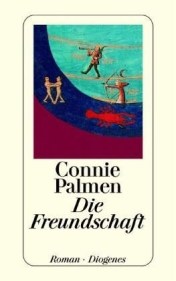
Thoughts on life, love, friendship, fear etc. from Connie Palmen’s Die Freundschaft

Connie Palmen, Die FreundschaftConnie Palmen, whose work I discovered only recently, is perhaps as much a philosopher as she is an author of fiction. Which should come as no surprise, as she studied both philosophy and Dutch literature.

Here are some quotes from Die Freundschaft:

In Worte zu fassen, was nicht unbedingt auf der Hand liegt, darin liegen für mich Glück und Befreiung.

(To put into words what is not necessarily obvious – in that for me lie happiness and liberation.)

Man wird ein bißchen irre, wenn man Tag für Tag immerzu leben muß …

(You get a little crazy, when you always have to live, day after day …)

Nicht der Haß ist das Gegenteil von Liebe, denn Haß muß man sich immer erst noch verdienen, sondern es ist diese Gleichgültigkeit.

(Not hatred is the opposite of love, for hatred you always still have to earn first – it is rather this indifference.)

Jemand, der maßlos nachdenkt, hat wahrscheinlich größere Angst vor dem Leben als andere.

(Somebody who reflects exorbitantly probably has a greater fear of life than others.)

Alle Süchte sind Versuche, die Sehnsucht nach Freundschaft aus eigener Kraft zu stillen, das heißt ohne dabei von jemand anders abhängig zu sein.

(All addictions are attempts to allay the longing for friendship out of one’s own strength, which is to say, without being dependent upon somebody else.)
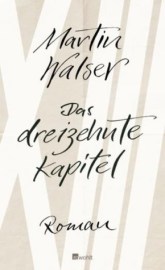
Best Reads 2013. I: Martin Walser, Das dreizehnte Kapitel

Martin Walser, Das dreizehnte KapitelMartin Walser’s latest novel talks about a chance meeting that leads to an intimate correspondence between a male author and a female theologian – and a love that, precisely because of its impossibility, is of the utmost intensity.

It is a poignant book about love, loss and pain. Here are some highlights:

Ich möchte nicht der sein, der ich war. Ich möchte der sein, der ich durch Dich bin.

(I do not want to be the one that I was. I want to be the one that I am through you.)

Streich das Warum.
Heiße den Schmerz willkommen.

(Erase the Why.
Welcome the pain.)

Ohne Unmögliches kann ich nicht leben. Umgeben von nichts als Möglichem erlischt das Leben selbst.

(Without the impossible I cannot live. Surrounded by nothing but the possible, life itself is extinguished.)

‘The Glass Essay’, by Anne Carson

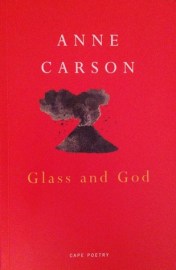
Carson, Glass and GodAnne Carson continues to capture (and haunt) my imagination. ‘The Glass Essay’ from her collection Glass and God is a powerful poem, in which a woman reflects on a lost love, the relationship with her mother, her father’s suffering from Altzheimer’s and the writings of Emily Brontë.

Here’s a description of the woman’s pain:

… Woman alone on a hill.
She stands into the wind.

It is a hard wind slanting from the north.
Long flaps and shreds of flesh rip off the woman’s body and lift
and blow away on the wind, leaving

an exposed column of nerve and blood and muscle
calling mutely through lipless mouth.

These are among my favourite lines:

I reach up and switch on the bedside lamp. Night springs

out the window and is gone over the moor.

Or how about this as a description of the morning light?

Astonished light is washing over the moor from north to east.

.