There is no choice then

Love is patient;
love is kind;
love is not envious
or boastful
or arrogant
or rude.

It does not insist on its own way;
it is not irritable or resentful;
it does not rejoice in wrongdoing,
but rejoices in the truth.

It bears all things,
believes all things,
hopes all things,
endures all things.

Love never ends.

These words from Paul’s First Letter to the Corinthians (13:4-8) have to be among the most challenging but also the wisest and truest comments ever made about love, true love, that is, love that fully deserves that name.

In ‘Decreation: How Women Like Sappho, Marguerite Porete and Simone Weil Tell God’, an essay I have referred to before, Anne Carson offers her own reflections on love, self and God in connection with the mysticism of Sappho, Marguerite Porete and Simone Weil. She notes, rightly, I think, that almost everything that passes as love is little more than self-love.

True love is characterised by patience and kindness. It cares for the Other, whoever that Other may be (love does not discriminate between who is, and isn’t, lovable), and does not insist on its own way. It bears, believes, hopes and endures everything; and it never ends. Now that is a challenge!

Yet, says Paul, I can have all knowledge and understanding, all faith even, but if I ‘do not have love, I am nothing’. There is no choice then, is there? It also is the most worthy of goals.
Hope is a participation in the very life of God

Hope is not logical, but a ‘participation in the very life of God’ (just like faith and love, which were called ‘theological virtues’ as opposed to virtues acquired by practice, temperament, or willpower). That doesn’t mean we should not practice being hopeful, but it is still not a matter of pure willpower. Faith, hope, and love are always somehow a gift – a cooperation with Someone Else, a participation in Something Larger than me.

Richard Rohr, ‘Some Effects of Mystical (“Experiential”) Encounter’ (Richard’s Daily Meditations, 9th March 2013)

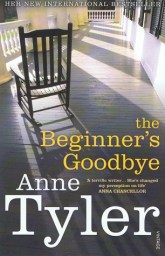
Best Reads 2013. IV: Anne Tyler, The Beginner’s Goodbye

Anne Tyler, The Beginner's GoodbyeYou probably wouldn’t read Anne Tyler for the plots of her novels. It’s not that nothing happens at all, though it would be fair to say that nothing much tends to happen. In any case, the plot is not what makes her books special. So why would you read Anne Tyler? Characterisation, I’d say, it’s all about characterisation.

The Beginner’s Goodbye is a novel about love and loss, grief and also, eventually, hope. When Aaron, an intriguing character, who stammers and suffers from the effects of polio, loses his wife (and house) in a freak accident, he finds his life drained of purpose and meaning.

The story is told from his perspective, the perspective of quite an ordinary kind of guy. And this, for me, is what makes the book special. Tyler deftly avoids the trap that all too many writers have fallen into, of using their characters as mouthpieces for their philosophical reflections, reflections that can easily become too sophisticated for the characters that are made to think and share all those amazing insights. Aaron is not cast in that way. Yes, he does offer us his reflections on life, love, grief and lots of other things (how could he not after all that’s happened to him?), but there is an ordinariness about him that makes him utterly real and believable.

Tyler has once again excelled at characterisation and come up with yet another very gentle book, to mention another one of her trademarks. Here are some of the little gems that Aaron dispenses:

… I had first tried to do without her – to ‘get over’ my loss, ‘find closure,’ ‘move on,’ all those ridiculous phrases people use when they’re urging you to endure the unendurable.

‘Reading is the first to go,’ my mother used to say, meaning that it was a luxury the brain dispensed with under duress.

That was one of the worst things about losing your wife, I found: your wife is the very person you want to discuss it all with.

As it turns out, Aaron grieves the loss of a marriage that had been far from perfect. It doesn’t get much more real than that, does it?

Divine love is incessantly restless

Some quotes from Belden Lane’s The Solace of Fierce Landscapes to complement my previous post:

The starting point for many things is grief, at the place where endings seem so absolute.

Divine love is incessantly restless until it turns all woundedness into health, all deformity into beauty, all embarrassment into laughter. In biblical faith, brokenness is never celebrated as an end in itself.

God can only be met in emptiness, by those who come in love, abandoning all effort to control …

… tragedy in one’s personal life can be trusted as a gift of God’s unfailing presence far more than trances, raptures, or visions received in so-called mystical experiences.

Referring to Moses’ and Elijah’s experience of God, Lane comments:

In both cases, their ‘seeing’ of God on the mountain was but an interlude in an ongoing struggle, given at a time when the absence of God seemed for them most painfully real. Transfiguration is a hidden, apocalyptic event, offering to those facing anguish a brief glimpse of glory to come. It incorporates a theology of hope into a theology of abandonment and loss.