Fifty Shades yet again

On my continuing journey through Fifty Shades of Feminism, edited by Lisa Appignanesi, Rachel Holmes and Susie Orbach, I have just come across a new highlight. It’s Susie Orbach’s contribution, entitled ‘A Love Letter to Feminism’. Like some of the other authors, she thinks back to the 1970s and how women were ‘daring to think and enact new ways of learning and living’.

I was particularly interested in her reflections on the fears these women had to face. ‘We began to appreciate how much patriarchy was a structure undermining us’, she says, ‘within and between women, as much as a political force outside us’. And again: ‘Internal psychological chains kept us in check and away from being as full as we could be.’

Orbach notes that she could have lived like so many women before her. But she counts herself lucky that she didn’t. Feminism, she says, gave her a proper life:

Without feminism, life’s challenges could and would have stained my individual experiences – as [they] for so many of my mother’s generation – turning them sour and bitter, rather than into places of learning. Without feminism I couldn’t have understood my personal dilemmas. Nor would I have had the capacity to reflect.

I was also moved by her comments on friendships that made it possible for her and other women to ‘think and enact new ways’:

exhilarating friendships took centre stage. They were a hammock underpinning our personal and collective struggles. We helped each other find and tell our stories as we were reshaping ourselves. Inside friendship we found ways to tackle our hesitancies, our fears, our insecurities, our shame and self-doubt.


Martin Luther King on love

Envy, jealousy, a lack of self-confidence, a feeling of insecurity, and a haunting sense of inferiority are all rooted in fear. … Is there a cure for these annoying fears that pervert our personal lives? Yes, a deep and abiding commitment to the way of love. ‘Perfect love casteth out fear.’

… hate divides the personality, and love in an amazing and inexorable way unites it.

We shall match your capacity to inflict suffering by our capacity to endure suffering. We shall meet your physical force with soul force. Do to us what you will, and we shall continue to love you. … But be ye assured that we will wear you down by our capacity to suffer. … Love is the most durable power in the world.

Martin Luther King Jr, Strength to Love

Of love, compassion and the unexpected angel of mercy

Without passion there’s no compassion. In the same way there has to be eros in the mixture if there is to be agape as well.

Thus open this morning’s ‘Lent Daily Reflections’ by the World Community for Christian Meditation. Both those sentences ring entirely true to me. It is through suffering that we learn to be compassionate; and true love is always marked by agape and eros.

The reflections then refer to Luke 22:41-44:

[Jesus] withdrew from them about a stone’s throw, knelt down, and prayed. He said, ‘Father, if it’s your will, take this cup of suffering away from me. However, not my will but your will must be done.’ Then a heavenly angel appeared to him and strengthened him. He was in anguish and prayed even more earnestly. His sweat became like drops of blood falling on the ground.

I have quoted this passage from the fairly new Common English Bible. Anyway, the reflections conclude:

This is no fairy tale. For any mature person it resonates with our own experience. Aloneness, anguish, fear, physical symptoms, the unexpected angel of mercy. But at the heart of it is the love [Jesus] felt holding him, which empowered him to love those he did not even, at that instant, consciously know.

There are two insights in this that resonate deeply with me: that we are empowered to love by being held in/by love ourselves, and that it is particularly in those experiences of intense suffering that we meet the unexpected angel of mercy.

Brief but insightful spiritual reflections on the book of Jonah

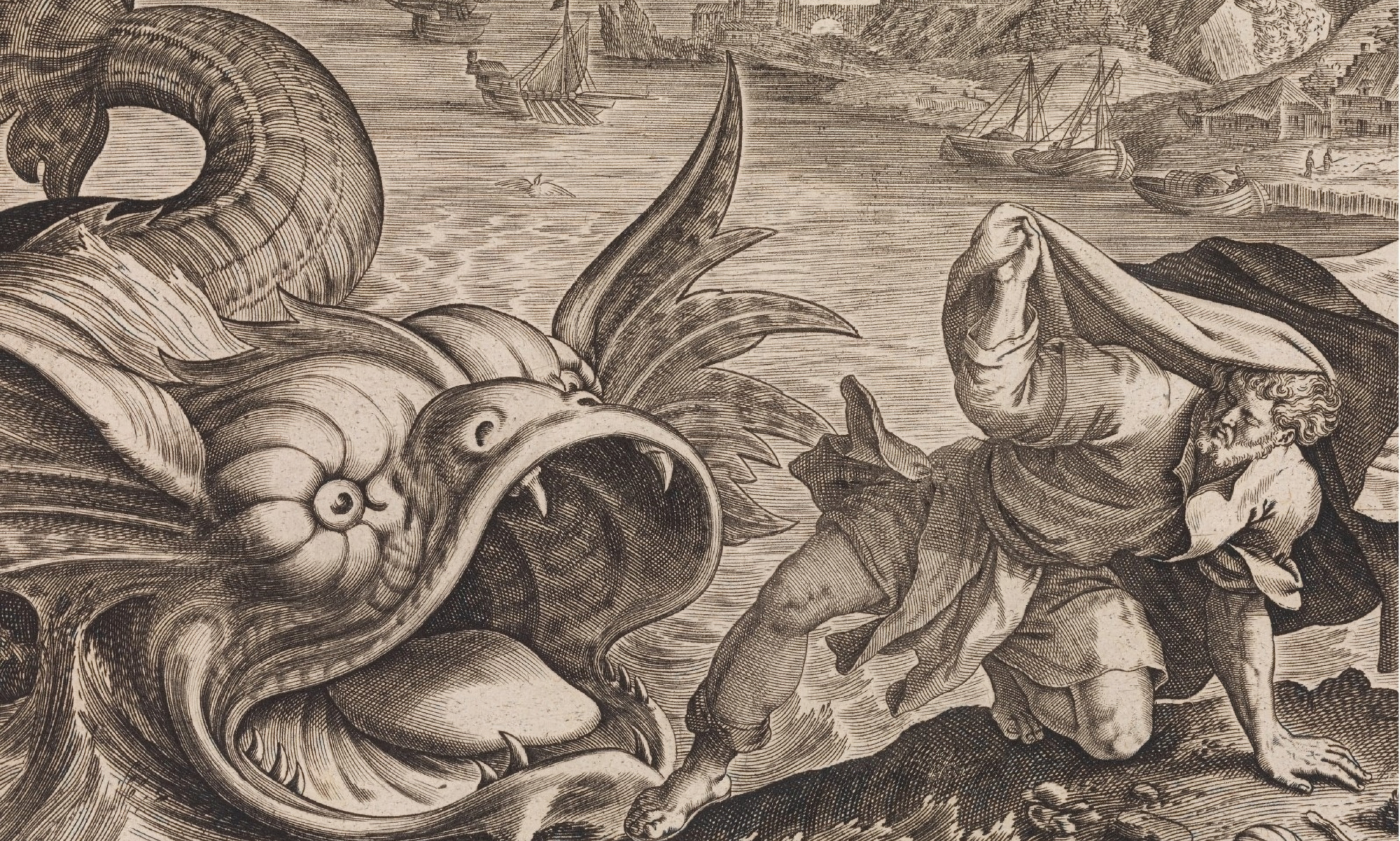
Paul Murray, A Journey with Jonah: The Spirituality of BewildermentPaul Murray’s book on the prophet Jonah, A Journey with Jonah: The Spirituality of Bewilderment, is a short one. Actually, it’s a very short one. Discounting the text of the book of Jonah itself and the illustrations, it runs to no more than 49 small pages. A pretty lightweight book then? Short, yes, but no, lightweight it isn’t. Although Murray, an Irish Dominican, obviously cannot give us an in-depth explanation of the text in those 49 pages, he has nonetheless written some quite remarkable reflections on this fascinating Old Testament text.

Murray is well-informed, and he manages, again rather surprisingly, given the limited space, to engage with an astonishing variety of perspectives, including modern scholarly treatments (Phyllis Trible, A. R. Ceresko, James Limburg, Yvonne Sherwood, André LaCocque, Jack Sasson, Hans Walter Wolff), works from the long history of Christian and Jewish engagement with this text (Jerome, Augustine, Methodius, Columban, Martin Luther, Rabbi Eliezer, the Zoar), poets, novelists and dramatists (Herman Melville, Francis Quarles, Wolf Mankowitz, Hart Crane, Robert Frost), philosophers and psychologists (George Steiner, Erich Fromm, Carl Gustav Jung, Martin Buber), mystics (John of the Cross, Teresa of Avila, Thomas Merton), the list goes on ….

More importantly, in his brief comments on the lesson of the wild storm, the lesson of the great whale (before anyone objects, Murray is well aware that the Hebrew text doesn’t mention a whale) and the lesson of the wondrous plant, Murray has given us some equally brief but nonetheless insightful spiritual reflections on fear, terror and courage; compassion, love and responsibility; suffering and bewilderment; failure and breakdown; death and resurrection; anger, resentment and bigotry ….

The following quotes may give a flavour of Murray’s writing:

… the moment of actual failure and breakdown – the experience of bewilderment in our lives – can be the moment of breakthrough, the moment when God’s grace finally shakes down all our defences. And then, to our amazement, from out of the belly of failure, from out of the death of false dreams and false ideals, and even from the jaws of a living hell, we can begin to experience the grace of resurrection.

… sometimes, it is only in the midst of the ‘tempest’, in the heart of a storm of circumstances which we can’t control, that we come finally to realise something of the wonderful mystery of God, and realise also how far beyond anything we can imagine or hope for are his plans both for ourselves and for the entire world.

Here’s something else that Murray has done for me. Having come across numerous references to John of the Cross’s reflections on the ‘dark night of the soul’ in recent months, Murray’s quotes from this text have finally persuaded me that I must go and read it!

Thoughts on life, love, friendship, fear etc. from Connie Palmen’s Die Freundschaft

Connie Palmen, Die FreundschaftConnie Palmen, whose work I discovered only recently, is perhaps as much a philosopher as she is an author of fiction. Which should come as no surprise, as she studied both philosophy and Dutch literature.

Here are some quotes from Die Freundschaft:

In Worte zu fassen, was nicht unbedingt auf der Hand liegt, darin liegen für mich Glück und Befreiung.

(To put into words what is not necessarily obvious – in that for me lie happiness and liberation.)

Man wird ein bißchen irre, wenn man Tag für Tag immerzu leben muß …

(You get a little crazy, when you always have to live, day after day …)

Nicht der Haß ist das Gegenteil von Liebe, denn Haß muß man sich immer erst noch verdienen, sondern es ist diese Gleichgültigkeit.

(Not hatred is the opposite of love, for hatred you always still have to earn first – it is rather this indifference.)

Jemand, der maßlos nachdenkt, hat wahrscheinlich größere Angst vor dem Leben als andere.

(Somebody who reflects exorbitantly probably has a greater fear of life than others.)

Alle Süchte sind Versuche, die Sehnsucht nach Freundschaft aus eigener Kraft zu stillen, das heißt ohne dabei von jemand anders abhängig zu sein.

(All addictions are attempts to allay the longing for friendship out of one’s own strength, which is to say, without being dependent upon somebody else.)