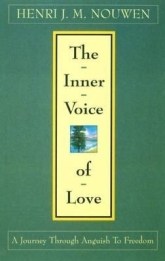
 his is one of the lesser known books by the late Dutch Roman Catholic priest Henri Nouwen, best remembered perhaps for books such as The Return of the Prodigal Son and The Wounded Healer. In the former, he briefly talks about giving up his distinguished academic career in order to work with people with mental disabilities at the L’Arche Daybreak Community in Toronto. In The Inner Voice of Love, Nouwen reveals that, during his time at L’Arche, he suffered a severe breakdown lasting about six months, a period he describes as the most difficult time of his life. It was, he says, ‘a time of extreme anguish, during which I wondered whether I would be able to hold on to my life’.
I felt that God had abandoned me. … The anguish completely paralysed me. I could no longer sleep. I cried uncontrollably for hours. I could not be reached by consoling words or arguments. I no longer had any interest in other people’s problems. I lost all appetite for food and could not appreciate the beauty of music, art, or even nature. All had become darkness. Within me there was one long scream coming from a place I didn’t know existed, a place full of demons.
The breakdown was triggered by the loss of a close friendship, which Nouwen describes in moving terms:
Going to L’Arche and living with very vulnerable people, I had gradually let go of many of my inner guards and opened my heart more fully to others. Among my many friends, one had been able to touch me in a way I had never been touched before. Our friendship encouraged me to allow myself to be loved and cared for with greater trust and confidence. It was a totally new experience for me, and it brought immense joy and peace. It seemed as if a door of my interior life had been opened, a door that had remained locked during my youth and most of my adult life.
When that friendship came to an end, Nouwen ‘lived through an agony that never seemed to end’. But, he says, he never lost the ability to write. Indeed, writing became part of his ‘struggle for survival’, and so he kept a secret journal, which was to be published years later as The Inner Voice of Love.
In this book, Nouwen describes how the loss of that friendship ultimately deepened his love of God, and how his suffering taught him compassion for others. There are many profound insights in these reflections on issues such as wounds and pain, friendship, love and compassion, God and spirituality, loneliness and transformation, the body, emotions and incarnation, community and living up to one’s calling.
The following quotes, offered without further comment and presented simply in the order in which they appear, give an illustration of the richness of Nouwen’s thought:
… those who seem to reject you … never speak about you. They speak about their own limitations. … They simply ask for your compassion.
Your willingness to let go of your desire to control your life reveals a certain trust. The more you relinquish your stubborn need to maintain power, the more you will get in touch with the One who has the power to heal and guide you. … As long as you run from where you are and distract yourself, you cannot fully let yourself be healed.
It is important that you dare to stay with your pain and allow it to be there.
When your deepest self is connected with the deepest self of another, that person’s absence may be painful, but it will lead you to a profound communion with the person, because loving each other is loving in God. When the place where God dwells in you is intimately connected with the place where God dwells in the other, the absence of the other person is not destructive. On the contrary, it will challenge you to enter more deeply into communion with God, the source of all unity and communion among people.
There is a real pain in your heart, a pain that truly belongs to you. You know now that you cannot avoid, ignore, or repress it. It is this pain that reveals to you how you are called to live in solidarity with the broken human race.
… real healing comes from realising that your own particular pain is a share in humanity’s pain. That realisation allows you to forgive your enemies and enter into a truly compassionate life.
The great challenge is living your wounds through instead of thinking them through. It is better to cry than to worry, better to feel your wounds deeply than to understand them …
It is you who decides what you think, say, and do. You can think yourself into a depression, you can talk yourself into low self-esteem, you can act in a self-rejecting way. But you always have a choice to think, speak, and act in the name of God and so move towards the Light, the Truth, and the Life.
There is much in this book, which I discovered quite by chance and only recently, that I can relate to in deep and profound ways. Nouwen’s journey from anguish to freedom is also one from hurt and pain to love and compassion, and that goal of a loving and compassionate life, while not making the hurt and pain any easier to endure, can give deep meaning to our struggles.
 ooking for something else, I stumbled across some quotes I copied from Wm. Paul Young’s The Shack some time ago. This book had a profound impact upon me at a time of the most intense inner turmoil. Rereading the extracts many months later, I was once again touched by the deep wisdom found in these lines.
 Karl Möller