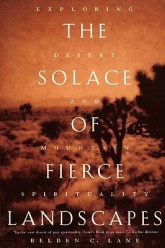
Best Reads 2013. III: Belden C. Lane, The Solace of Fierce Landscapes: Exploring Desert and Mountain Spirituality

Belden C. Lane, The Solace of Fierce Landscapes: Exploring Desert and Mountain SpiritualityThe Solace of Fierce Landscapes, says Frances Young in Brokenness and Blessing, is the kind of book she would have liked to have written herself. Published by Oxford University Press, this is a well-informed exploration of desert spirituality. But it offers more than that. Talking about ‘the permeable boundaries between critical scholarship and lived experience’, Belden Lane also reflects on his own experience of spending time in wilderness places; and he gives a very personal account of his journey alongside his dying mother’s struggle with Alzheimer’s and cancer as well as his attempt to come to terms with his father’s somewhat mysterious death earlier on in his life.

The book is in three parts, which reflect the traditional three stages of the spiritual life: Purgation: Emptiness in a Geography of Abandonment; Illumination: Waiting in a Silence Beyond Language; and Union: Love as the Fruit of Indifference. These three stages, notes Lane, are symbolised by the desert, the mountain and the cloud.

There are chapters on:

  • spirituality and the environment,
  • wild terrain and the spiritual life,
  • prayer without language in the mystical tradition,
  • the symbolism of Mounts Sinai and Tabor in the Christian tradition,
  • the landscape and theology of early Christian monasticism,
  • the desert Christians’ counter-cultural spirituality of attentiveness, indifference and love.

And, to give you another list, which is the only way I can even begin to do justice to the book’s richness without giving an extensively long account, Lane offers insightful thoughts on:

  • abandonment of control (and the desert as teacher of renunciation and abandonment),
  • letting go and the emptying of self,
  • loving that which cannot be understood,
  • the power of compassion as the fruit of indifference (the notion of indifference might require some explanation, but you have to read Lane for that),
  • a new harmony with the land,
  • learning to pay attention,
  • the transformation of desire into love,
  • meeting love in the most unlikely places,
  • the power of silence to connect and heal,
  • liturgy and the reaffirmation of ordinariness.

Woven into the fabric of the book are interludes, called ‘mythic landscapes’, in which Lane takes his personal account of the journey with his dying mother as well as his repeated experiences of wilderness places as the starting point for further reflections on issues such as a spirituality of brokenness, the gift of nothingness in a desert landscape, the unexpected gifts of grief, and a spirituality of desire.

Having had some recent desert experiences myself, I have found this a rich and rewarding read.
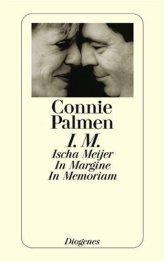
Best Reads 2013. II: Connie Palmen, I. M.: Ischa Meijer. In Margine. In Memoriam

Connie Palmen, I. M.: Ischa Meijer. In Margine. In MemoriamIn February 1991 Dutch author Connie Palmen is interviewed by the well-known talk show host and journalist Ischa Meijer. It is a meeting that changes the course of their lives, and what ensues is a relationship that is not easily matched for intensity. In this stunning and admirably honest autobiographical work Palmen reflects on their love and brokenness. And she gives us insights into the working habits and practices of two writers, whose approaches to their work couldn’t have been more different but who nonetheless profited immensely from what was an intensely symbiotic relationship.

This is also a book about travel, especially in North America, which Palmen and Meijer both adored, and it is a heart-rending and very honest account of loss and grief, because in 1995 Meijer dies from a sudden heart attack. Palmen devotes only the last forty pages to her struggle to come to terms with her loss and grief, but these are poignant pages indeed. My quotes from Palmen’s reflections come from this final part of her book:

Und inmitten dieses lautlosen Tumults lernte ich meinen Gott kennen, der in mir geboren wurde und der, so versicherte Er mir selbst, schon immer dagewesen war. Er verband mich mit allen Zeiten und allen Menschen, tot oder lebendig.

(And in the midst of this soundless tumult I got to know my God, who was born within me and who, so he ensured me himself, had always been there. He connected me with all times and all people, dead or alive.)

Sucht ist eine Freundschaft ohne Freund. Du suchst, was in unmittelbarer Nähe und greifbar ist. Eine Zigarette ist ein Halt, ein Halt, der verbrennt. Der größte Vorzug einer Schachtel Marlboro ist, daß sie dich nicht betrügen kann, dich nicht verlassen kann, daß sie niemals aufhören wird, dich zu lieben, und natürlich, daß sie nicht sterben kann. Das ist die Essenz einer Sucht, glaube ich. Du umgehst die Risiken, die du bei einer Liebe oder Freundschaft notgedrungen eingehst, weil du sonst keine Liebe und keine Freundschaft hättest.

(Addiction is a friendship without a friend. You search for something that is close and tangible. A cigarette is a foothold, a foothold that is consumed by fire. The biggest advantage of a box of Marlboro is that it cannot betray you, cannot leave you, that it will never stop loving you and, of course, that it cannot die. That is the essence of an addiction, I believe. You avoid the risks that you inevitably run in the case of love or friendship, because otherwise you wouldn’t have love or friendship.)

Ich mache die Trauer zur Vollzeitbeschäftigung.

(I am turning grief into a full-time occupation.)

Ich denke wie verrückt, aber es nützt mir nichts.

(I am thinking like mad, but it is to no avail.)

Gutes, Amüsantes und Schönes läßt mich leiden, weil ich es allein sehen muß, es nicht mit ihm teilen und dadurch verdoppeln kann, weil er nicht mehr genießen kann, was ich genieße.

(Good, amusing and beautiful things make me suffer, because I have to see them on my own, can’t share them with him, thus redoubling them, because he can’t enjoy anymore what I am enjoying.)

Best Reads 2013. I: Martin Walser, Das dreizehnte Kapitel

Martin Walser, Das dreizehnte KapitelMartin Walser’s latest novel talks about a chance meeting that leads to an intimate correspondence between a male author and a female theologian – and a love that, precisely because of its impossibility, is of the utmost intensity.

It is a poignant book about love, loss and pain. Here are some highlights:

Ich möchte nicht der sein, der ich war. Ich möchte der sein, der ich durch Dich bin.

(I do not want to be the one that I was. I want to be the one that I am through you.)

Streich das Warum.
Heiße den Schmerz willkommen.

(Erase the Why.
Welcome the pain.)

Ohne Unmögliches kann ich nicht leben. Umgeben von nichts als Möglichem erlischt das Leben selbst.

(Without the impossible I cannot live. Surrounded by nothing but the possible, life itself is extinguished.)