The heart sings

Typography, another fascination of mine. Although it is one that I have been paying far too little attention to in recent years. I’m not entirely sure why. Perhaps I have been too preoccupied with work. Beauty is important though because it lifts the spirit. It really ought not to be neglected. Having begun to realise that I have been quite wrong to do so, I am all the more determined to make time for the contemplation and pursuit of beauty.

One thing that I truly delight in is beautiful lettering and typography, and so I was very excited when I discovered Jessica Hische’s beautiful site Daily Drop Cap, which features a plethora of illustrative initial caps that can be reproduced free of charge on non-commercial sites. I shall make good use of them on ‘Brief thoughts & quotes’ from now on.

By the way, I came across Jessica’s site on Nonsuch Book, a bibliophile blog that also alerted me to the fact that Jessica has been involved in the design of Penguin’s beautiful Drop Caps series, an example of which is shown below.
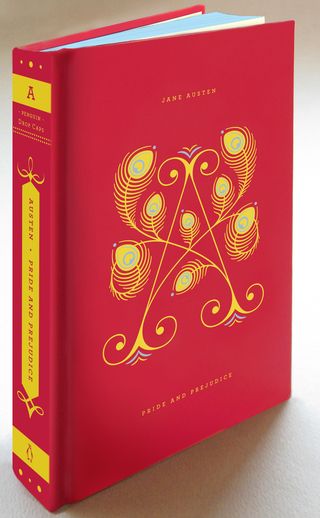
Jessica Hische's Design of Jane Austin's 'Pride and Prejudice'
Jessica Hische’s design of Jane Austin’s ‘Pride and Prejudice’

What can I say? The heart sings when it sees a book like this!

Love life fiercely

Love for beauty; care for the material life that gives pleasure and joy; appreciation for the numinous world, revealed by the Spirit in life; and embrace of the eros that empowers human beings as social creatures to seek others – these are spiritual powers that deliver salvation.

We reenter this world as sacred space when we love life fiercely, and, in the name of love, protect the goodness of our intricate web of life in all its manifold forms. We recommit ourselves to this world as holy ground when we remember the fullness of life that is possible through our communities, our life-affirming rituals, and our love of beauty, of truth, of goodness.

Rita Nakashima Brock, ‘Paradise and Desire: Deconstructing the Eros of Suffering’, in F. LeRon Shults and Jan-Olav Henriksen (eds), Saving Desire: The Seduction of Christian Theology

Divine love is incessantly restless

Some quotes from Belden Lane’s The Solace of Fierce Landscapes to complement my previous post:

The starting point for many things is grief, at the place where endings seem so absolute.

Divine love is incessantly restless until it turns all woundedness into health, all deformity into beauty, all embarrassment into laughter. In biblical faith, brokenness is never celebrated as an end in itself.

God can only be met in emptiness, by those who come in love, abandoning all effort to control …

… tragedy in one’s personal life can be trusted as a gift of God’s unfailing presence far more than trances, raptures, or visions received in so-called mystical experiences.

Referring to Moses’ and Elijah’s experience of God, Lane comments:

In both cases, their ‘seeing’ of God on the mountain was but an interlude in an ongoing struggle, given at a time when the absence of God seemed for them most painfully real. Transfiguration is a hidden, apocalyptic event, offering to those facing anguish a brief glimpse of glory to come. It incorporates a theology of hope into a theology of abandonment and loss.

Beauty and intimacy

Some further thoughts on beauty, this time in connection with intimacy. Paul J. Griffiths, in his commentary on the Song of Songs, notes that

it is rare for us to be dazzled by beauty … without seeking some kind of intimacy with it. [However,] appreciation of beauty can be heightened by certainty that there will be no physical intimacy with it; [and yet,] appreciation for and delight in beauty may not survive physical intimacy with it, and will certainly be altered thereby.

Griffiths’ commentary is a stimulating read, even if it is not one I would recommend to those seeking to acquaint themselves with the Song of Songs. Why? Because Griffiths comments on the Latin text of the Vulgate rather than the Hebrew original, and he focuses quite strongly on figurative readings of the Song.

WOW! You’re lookin’ good!

WOW! You’re lookin’ good!Not sure now where I found this, but what a brilliant illustration of the absurdity of literalistic interpretation.

The following is my still somewhat preliminary translation of Song of Songs 4:1-7. I especially love the wonderful way of referring to the break of day in v. 6, ‘until the day breathes / and the shadows flee’.

You are so beautiful, my love.
You are so beautiful.
Your eyes are doves
looking out from behind your locks.
Your hair is like a flock of goats
streaming down Mount Gilead.

Your teeth are like a flock ready to be shorn
that have come up from the washing pool,
every one of them having twins,
not one of them bereaved of offspring.

Like a scarlet ribbon are your lips;
your mouth is beautiful.
Like a slice of pomegranate gleams your brow
from behind your locks.

Like the tower of David is your neck,
built to perfection.
A thousand bucklers hang on it,
all kinds of warriors’ shields.

Your breasts are like two fawns,
twins of a gazelle,
which feed among the lotuses.

Until the day breathes
and the shadows flee
I will go to the mountain of myrrh,
to the hill of frankincense.

All of you is beautiful, my love;
there is no flaw in you.

Beauty is realised eschatology

… beauty is realized eschatology, the present glow of the sheer goodness that will be at the end.

Thus Robert W. Jenson in his commentary on the descriptive poem in Song of Songs 4:1-7. Beauty as realised eschatology – what an intriguing thought.