Best Reads 2013. II: Connie Palmen, I. M.: Ischa Meijer. In Margine. In Memoriam

Connie Palmen, I. M.: Ischa Meijer. In Margine. In MemoriamIn February 1991 Dutch author Connie Palmen is interviewed by the well-known talk show host and journalist Ischa Meijer. It is a meeting that changes the course of their lives, and what ensues is a relationship that is not easily matched for intensity. In this stunning and admirably honest autobiographical work Palmen reflects on their love and brokenness. And she gives us insights into the working habits and practices of two writers, whose approaches to their work couldn’t have been more different but who nonetheless profited immensely from what was an intensely symbiotic relationship.

This is also a book about travel, especially in North America, which Palmen and Meijer both adored, and it is a heart-rending and very honest account of loss and grief, because in 1995 Meijer dies from a sudden heart attack. Palmen devotes only the last forty pages to her struggle to come to terms with her loss and grief, but these are poignant pages indeed. My quotes from Palmen’s reflections come from this final part of her book:

Und inmitten dieses lautlosen Tumults lernte ich meinen Gott kennen, der in mir geboren wurde und der, so versicherte Er mir selbst, schon immer dagewesen war. Er verband mich mit allen Zeiten und allen Menschen, tot oder lebendig.

(And in the midst of this soundless tumult I got to know my God, who was born within me and who, so he ensured me himself, had always been there. He connected me with all times and all people, dead or alive.)

Sucht ist eine Freundschaft ohne Freund. Du suchst, was in unmittelbarer Nähe und greifbar ist. Eine Zigarette ist ein Halt, ein Halt, der verbrennt. Der größte Vorzug einer Schachtel Marlboro ist, daß sie dich nicht betrügen kann, dich nicht verlassen kann, daß sie niemals aufhören wird, dich zu lieben, und natürlich, daß sie nicht sterben kann. Das ist die Essenz einer Sucht, glaube ich. Du umgehst die Risiken, die du bei einer Liebe oder Freundschaft notgedrungen eingehst, weil du sonst keine Liebe und keine Freundschaft hättest.

(Addiction is a friendship without a friend. You search for something that is close and tangible. A cigarette is a foothold, a foothold that is consumed by fire. The biggest advantage of a box of Marlboro is that it cannot betray you, cannot leave you, that it will never stop loving you and, of course, that it cannot die. That is the essence of an addiction, I believe. You avoid the risks that you inevitably run in the case of love or friendship, because otherwise you wouldn’t have love or friendship.)

Ich mache die Trauer zur Vollzeitbeschäftigung.

(I am turning grief into a full-time occupation.)

Ich denke wie verrückt, aber es nützt mir nichts.

(I am thinking like mad, but it is to no avail.)

Gutes, Amüsantes und Schönes läßt mich leiden, weil ich es allein sehen muß, es nicht mit ihm teilen und dadurch verdoppeln kann, weil er nicht mehr genießen kann, was ich genieße.

(Good, amusing and beautiful things make me suffer, because I have to see them on my own, can’t share them with him, thus redoubling them, because he can’t enjoy anymore what I am enjoying.)

Brief but insightful spiritual reflections on the book of Jonah

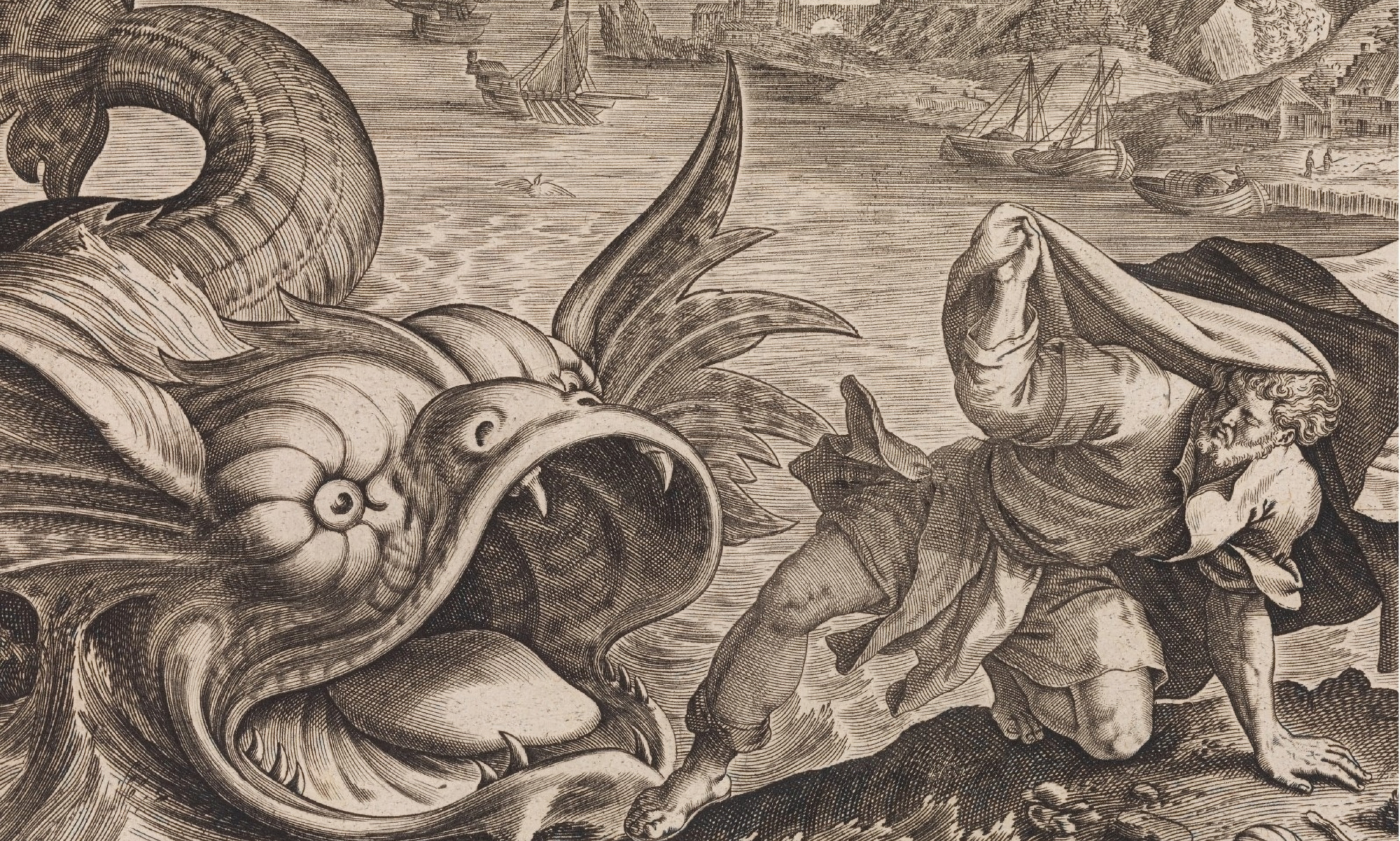
Paul Murray, A Journey with Jonah: The Spirituality of BewildermentPaul Murray’s book on the prophet Jonah, A Journey with Jonah: The Spirituality of Bewilderment, is a short one. Actually, it’s a very short one. Discounting the text of the book of Jonah itself and the illustrations, it runs to no more than 49 small pages. A pretty lightweight book then? Short, yes, but no, lightweight it isn’t. Although Murray, an Irish Dominican, obviously cannot give us an in-depth explanation of the text in those 49 pages, he has nonetheless written some quite remarkable reflections on this fascinating Old Testament text.

Murray is well-informed, and he manages, again rather surprisingly, given the limited space, to engage with an astonishing variety of perspectives, including modern scholarly treatments (Phyllis Trible, A. R. Ceresko, James Limburg, Yvonne Sherwood, André LaCocque, Jack Sasson, Hans Walter Wolff), works from the long history of Christian and Jewish engagement with this text (Jerome, Augustine, Methodius, Columban, Martin Luther, Rabbi Eliezer, the Zoar), poets, novelists and dramatists (Herman Melville, Francis Quarles, Wolf Mankowitz, Hart Crane, Robert Frost), philosophers and psychologists (George Steiner, Erich Fromm, Carl Gustav Jung, Martin Buber), mystics (John of the Cross, Teresa of Avila, Thomas Merton), the list goes on ….

More importantly, in his brief comments on the lesson of the wild storm, the lesson of the great whale (before anyone objects, Murray is well aware that the Hebrew text doesn’t mention a whale) and the lesson of the wondrous plant, Murray has given us some equally brief but nonetheless insightful spiritual reflections on fear, terror and courage; compassion, love and responsibility; suffering and bewilderment; failure and breakdown; death and resurrection; anger, resentment and bigotry ….

The following quotes may give a flavour of Murray’s writing:

… the moment of actual failure and breakdown – the experience of bewilderment in our lives – can be the moment of breakthrough, the moment when God’s grace finally shakes down all our defences. And then, to our amazement, from out of the belly of failure, from out of the death of false dreams and false ideals, and even from the jaws of a living hell, we can begin to experience the grace of resurrection.

… sometimes, it is only in the midst of the ‘tempest’, in the heart of a storm of circumstances which we can’t control, that we come finally to realise something of the wonderful mystery of God, and realise also how far beyond anything we can imagine or hope for are his plans both for ourselves and for the entire world.

Here’s something else that Murray has done for me. Having come across numerous references to John of the Cross’s reflections on the ‘dark night of the soul’ in recent months, Murray’s quotes from this text have finally persuaded me that I must go and read it!

Thoughts on life, love, friendship, fear etc. from Connie Palmen’s Die Freundschaft

Connie Palmen, Die FreundschaftConnie Palmen, whose work I discovered only recently, is perhaps as much a philosopher as she is an author of fiction. Which should come as no surprise, as she studied both philosophy and Dutch literature.

Here are some quotes from Die Freundschaft:

In Worte zu fassen, was nicht unbedingt auf der Hand liegt, darin liegen für mich Glück und Befreiung.

(To put into words what is not necessarily obvious – in that for me lie happiness and liberation.)

Man wird ein bißchen irre, wenn man Tag für Tag immerzu leben muß …

(You get a little crazy, when you always have to live, day after day …)

Nicht der Haß ist das Gegenteil von Liebe, denn Haß muß man sich immer erst noch verdienen, sondern es ist diese Gleichgültigkeit.

(Not hatred is the opposite of love, for hatred you always still have to earn first – it is rather this indifference.)

Jemand, der maßlos nachdenkt, hat wahrscheinlich größere Angst vor dem Leben als andere.

(Somebody who reflects exorbitantly probably has a greater fear of life than others.)

Alle Süchte sind Versuche, die Sehnsucht nach Freundschaft aus eigener Kraft zu stillen, das heißt ohne dabei von jemand anders abhängig zu sein.

(All addictions are attempts to allay the longing for friendship out of one’s own strength, which is to say, without being dependent upon somebody else.)

And so I’m hooked. Rumi (as mediated by Coleman Barks)

Having come across Rumi a few times in references by several writers, I was finally persuaded to give him a go when a woman I met on a recent trip to Chicago recommended him most enthusiastically. And so I began reading him. And so I’m hooked.

But am I really reading Rumi, or am I reading Coleman Barks, in whose translation I am currently encountering him? For Barks does not read Persian and thus can only work from literal, scholarly transcriptions. And he has apparently taken not a few liberties in creating poems that feature, in the words of Franklin Lewis (in Rumi: Past, Present, East and West. The Life, Teachings and Poetry of Jalâl al-Din Rumi), ‘a modern American idiom’ and present Rumi’s originally ‘rhythmic and perhaps even trance-like’ poetry as free verse.

Does this really matter though? Well, yes and no, I suppose. Yes in that, as again Lewis points out, Barks, due to his lack of Persian, sometimes misunderstands the original while also teleporting the poems out of their cultural and Islamic context into a modern ecumenical American one. Yet I do believe Barks is right to claim that Rumi would have wanted his poems to resonate with audiences from a different culture. And in Barks’s translation they do, which is why I’m hooked. Would I have been as interested if I had encountered Rumi in wooden, literal transcriptions? Probably not.

There is one thing that worries me a little though. According to Lewis, Barks has turned this ‘poet of overpowering longing, [who is] trying to grope through his acute and shattering sense of loss’, into a serene dispenser of wisdom. That frenetically searching poet I would have liked to meet, but I’m hooked regardless. And Barks does give us beautiful poetry.

Best Reads 2013. I: Martin Walser, Das dreizehnte Kapitel

Martin Walser, Das dreizehnte KapitelMartin Walser’s latest novel talks about a chance meeting that leads to an intimate correspondence between a male author and a female theologian – and a love that, precisely because of its impossibility, is of the utmost intensity.

It is a poignant book about love, loss and pain. Here are some highlights:

Ich möchte nicht der sein, der ich war. Ich möchte der sein, der ich durch Dich bin.

(I do not want to be the one that I was. I want to be the one that I am through you.)

Streich das Warum.
Heiße den Schmerz willkommen.

(Erase the Why.
Welcome the pain.)

Ohne Unmögliches kann ich nicht leben. Umgeben von nichts als Möglichem erlischt das Leben selbst.

(Without the impossible I cannot live. Surrounded by nothing but the possible, life itself is extinguished.)