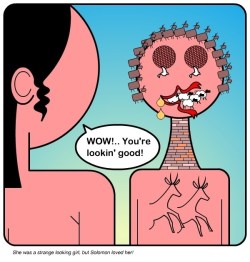
WOW! You’re lookin’ good!

WOW! You’re lookin’ good!Not sure now where I found this, but what a brilliant illustration of the absurdity of literalistic interpretation.

The following is my still somewhat preliminary translation of Song of Songs 4:1-7. I especially love the wonderful way of referring to the break of day in v. 6, ‘until the day breathes / and the shadows flee’.

You are so beautiful, my love.
You are so beautiful.
Your eyes are doves
looking out from behind your locks.
Your hair is like a flock of goats
streaming down Mount Gilead.

Your teeth are like a flock ready to be shorn
that have come up from the washing pool,
every one of them having twins,
not one of them bereaved of offspring.

Like a scarlet ribbon are your lips;
your mouth is beautiful.
Like a slice of pomegranate gleams your brow
from behind your locks.

Like the tower of David is your neck,
built to perfection.
A thousand bucklers hang on it,
all kinds of warriors’ shields.

Your breasts are like two fawns,
twins of a gazelle,
which feed among the lotuses.

Until the day breathes
and the shadows flee
I will go to the mountain of myrrh,
to the hill of frankincense.

All of you is beautiful, my love;
there is no flaw in you.

‘When anyone escapes, my heart leaps up’ – Sharon Olds’s Stag’s Leap

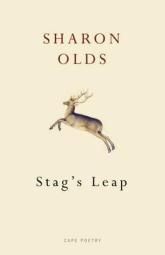
Sharon Olds, Stag’s LeapStag’s Leap by Sharon Olds is a book of poetry, written after her husband had left her for another woman. I picked this up the other day because (a) I needed something to read over lunch, (b) the subject matter intrigued me, (c) the blurb had succeeded in deepening my interest, (d) the book has won the T. S. Eliot Prize 2012 and (e) I felt like buying a poetry book (I actually bought two as it happens, but that’s a story for another day). Olds’s book also reminded me of Anne Carson’s The Beauty of the Husband, which similarly won the T. S. Eliot Prize, deals with the loss of a husband, is published by Cape Poetry and which I had enjoyed.

Stag’s Leap then. This is a sequence of poems (though not quite a narrative poem in the sense of Carson’s Autobiography of Red) divided into six parts – January–December, Winter, Spring, Summer, Fall, Years Later – in which Olds reflects on love, the body, sex, loss, betrayal, divorce, pain, grief, anger, hatred ….

There are many poignant moments in these poems, but the earlier reflections in ‘January–December’ and ‘Winter’ moved me the most.

Now I come back to look at love
in a new way, now that I know I’m not
standing in its light. …

I am not here – to stand in his thirty-year
sight, and not in love’s sight,
I feel an invisibility

In the absence of love, Olds reflects, all that remains is ‘courtesy and horror’.

And yet, despite the horror and the pain, there are admirable expressions of tenderness and love even at the moment of separation:

In the last minute of our marriage, I looked into
his eyes. All that day until then, I had been
comforting him, for the shock he was in
at his pain – the act of leaving me
took him back, to his own early
losses. But now it was time to go beyond
comfort, to part. …

Olds finds it possible to think back on how blessed her life had been, partly because she had been able to love and had not lost her husband while he still loved her.

Here is another surprising and rather touching revelation:

… When anyone escapes, my heart
leaps up. Even when it’s I who am escaped from,
I am half on the side of the leaver. …

The poems talk about Olds’s shame at having been left by the one who knew her best. She notes how every hour is a ‘room of shame’ but also how there’s a ‘being of sheer hate’ inside her and how, since it cannot harm him, she can wound him, in her dream.

And she reflects on having lived with an idea, an illusion of her former husband, whom she did not truly see or know.

‘Years later’, she says:

… Maybe I’m half over who he
was, but not who I thought he was, and not
over the wound, sudden deathblow
as if out of nowhere, though it came from the core
of our life together. …

Even so, she can’t let go of him yet but holds him on a string, watching her idea of him pull away yet stay, her ‘silver kite’.

These poems poignantly express the conflicting emotions experienced in the wake of betrayal and loss.
Beauty is realised eschatology

… beauty is realized eschatology, the present glow of the sheer goodness that will be at the end.

Thus Robert W. Jenson in his commentary on the descriptive poem in Song of Songs 4:1-7. Beauty as realised eschatology – what an intriguing thought.

Learning from monks, nuns and friars

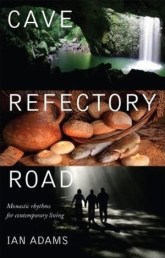
Ian Adams, Cave, Refectory, Road: Monastic Rhythms for Contemporary LivingCave, Refectory, Road: Monastic Rhythms for Contemporary Living by Ian Adams, another short book of just under 100 pages, adopts an approach to spirituality and Christian living that seeks to learn from the strengths of the monastic tradition. It represents the movement of ‘new monasticism’, in which key monastic principles are applied to ‘regular life’ in a non-monastic setting.

Such a life finds expression in the cave, which symbolises withdrawal in order to make space for stillness, prayer and contemplation; the refectory, which stands for commitment to a place and community, for hospitality and presence; and the road, the life that is open to travel, encounter and world-engagement.

Adams offers perceptive comments on the monastic rhythm of life with its different approach to time, prioritising prayer, silence and stillness over everything else; and there are thoughtful chapters on the monastic vows of poverty, chastity, obedience and stability, which are reinterpreted as simplicity, devotion, humility and rootedness.

This is a gentle and reflective book that seeks to point the way to an authentic spirituality focused on being and living.

Let’s do absolutely nothing – the #NOTBUSY Lent campaign

Stephen Cherry, Beyond Busyness: Time Wisdom in an HourPerhaps I should explain the new ‘I’m not busy’ badge in the top right hand corner of this blog. I read a little book by Stephen Cherry yesterday, which is part of a Lent campaign (see http://www.notbusy.co.uk/) and a fascinating one at that. Lent is a time when Christians remember the time Jesus spent fasting in the desert. For many it is a time of giving things up. Traditionally, people would have given up certain foods, especially meat, during Lent, but these days it could be other things, such as social networking, to name only one example.

Cherry encourages us to give up busyness. Yes, that’s right, busyness!

His book, which is an ebook and a very quick read (apparently it’s the equivalent of no more than 41 printed pages), includes a number of helpful suggestions as well as a proper definition of the kind of busyness that Cherry thinks is unhelpful and even dangerous. One of his ideas is that we take 10–30 minutes each day doing absolutely nothing but living in the present and noticing the things around us. What a brilliant and truly counter-cultural suggestion!

Readers will have to turn to the book for more ideas and for Cherry’s thoughts on busyness and what he calls ‘time wisdom’, but here are some quotes on time and spirituality, the part of his book I most enjoyed, to whet your appetite:

… since time is a fundamental dimension and aspect of creation, spirituality connects us more realistically with time.

Busyness, in its new and chronic guise, is toxic to spirituality and to wellbeing precisely because it eliminates the possibility of the spiritual appreciation of the passing moment …

To give up busyness … is to seek to walk through the door of the present moment into the world of spiritual delights and challenges.

.

Of quotes, oranges and banditry – an Anne Carson quote, what else?

As this blog is entitled ‘Brief thoughts and quotes’, how could I not quote Anne Carson’s thoughts about quotes in ‘Foam (Essay with Rhapsody): On the Sublime in Longinus and Antonioni’ in Decreation: Poetry, Essays, Opera?

A quote (cognate with quota) is a cut, a section, a slice of someone else’s orange. You suck the slice, toss the rind, skate away. Part of what you enjoy in a documentary technique is the sense of banditry. To loot someone else’s life or sentences and make off with a point of view, which is called ‘objective’ because you can make anything into an object by treating it this way, is exciting and dangerous.