Best Reads 2013. V: Anne Carson, Antigonick

Anne Carson, AntigonickThis is Anne Carson’s translation (and adaptation) of Sophocles’ play Antigone. Following on from Nox, an epitaph written on the occasion of her brother’s death, Carson here revisits the theme of mourning a lost brother, for the heroine of Sophocles’ play is condemned to nothing less than a living death in a sealed cave, all because she wished to bury her dead brother.

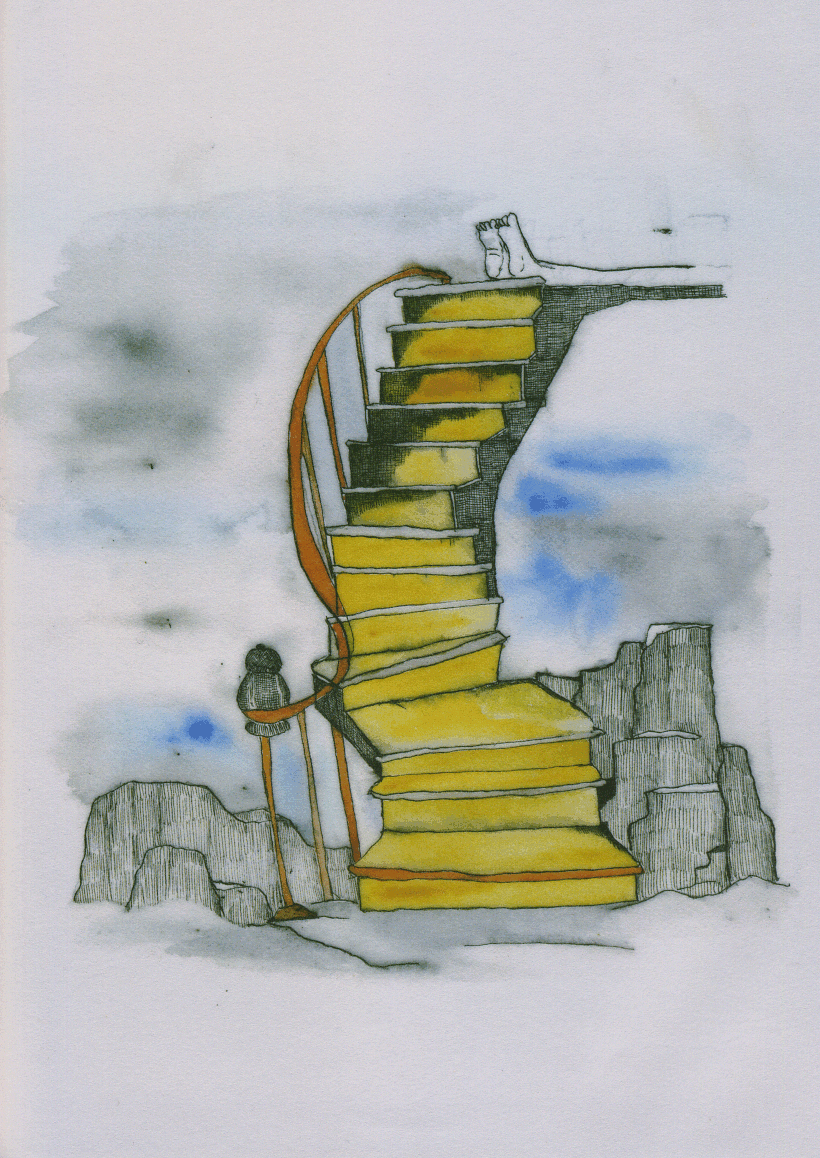
Anne Carson, AntigonickAntigonick is a powerfully compelling work, beautifully executed while at the same time, in typical Anne Carson fashion, bordering on the incomprehensible. The text is presented in handwriting (apparently Carson’s own), in capital letters and with hardly any punctuation. It is interlaced with rather surreal illustrations by Bianca Stone, printed on transparent vellum that overlays the text. It is not always clear how the illustrations relate to the text, but they contribute significantly to the beauty and appeal of the book as well as to its overall impact by heightening the absurdity of the world that Carson’s rereading presents.
Anne Carson, Antigonick
Illustration by Bianca Stone

Not an easy read this, but a fascinating one. Like Nox, it left me intrigued and deeply touched by Carson’s creative and harrowing ways of mourning her brother’s death.
Hope is a participation in the very life of God

Hope is not logical, but a ‘participation in the very life of God’ (just like faith and love, which were called ‘theological virtues’ as opposed to virtues acquired by practice, temperament, or willpower). That doesn’t mean we should not practice being hopeful, but it is still not a matter of pure willpower. Faith, hope, and love are always somehow a gift – a cooperation with Someone Else, a participation in Something Larger than me.

Richard Rohr, ‘Some Effects of Mystical (“Experiential”) Encounter’ (Richard’s Daily Meditations, 9th March 2013)

The time is now

The time is now, the forever now, for all of us to be engaged. To love fully, to be mindful, to care, to show up for this life.

Elizabeth Wurtzel, ‘The New C-Word’

Why read the Song of Songs?

I am hoping, in due course, to share some of the fruits of my engagement with Song of Songs 4:1-7 with readers of this blog. However, before I get on to that, I thought it interesting to address the question why we would want to read this book in the first place. It is, after all, quite an ancient text, which originates from a different time and culture and, being full of rather bizarre-looking metaphors, is not an easy read either. So why might we want to read the Song of Songs?

There won’t be any suggestions just yet. I am happy simply to pose the question for now, although I will be back with some thoughts.

Best Reads 2013. IV: Anne Tyler, The Beginner’s Goodbye

Anne Tyler, The Beginner's GoodbyeYou probably wouldn’t read Anne Tyler for the plots of her novels. It’s not that nothing happens at all, though it would be fair to say that nothing much tends to happen. In any case, the plot is not what makes her books special. So why would you read Anne Tyler? Characterisation, I’d say, it’s all about characterisation.

The Beginner’s Goodbye is a novel about love and loss, grief and also, eventually, hope. When Aaron, an intriguing character, who stammers and suffers from the effects of polio, loses his wife (and house) in a freak accident, he finds his life drained of purpose and meaning.

The story is told from his perspective, the perspective of quite an ordinary kind of guy. And this, for me, is what makes the book special. Tyler deftly avoids the trap that all too many writers have fallen into, of using their characters as mouthpieces for their philosophical reflections, reflections that can easily become too sophisticated for the characters that are made to think and share all those amazing insights. Aaron is not cast in that way. Yes, he does offer us his reflections on life, love, grief and lots of other things (how could he not after all that’s happened to him?), but there is an ordinariness about him that makes him utterly real and believable.

Tyler has once again excelled at characterisation and come up with yet another very gentle book, to mention another one of her trademarks. Here are some of the little gems that Aaron dispenses:

… I had first tried to do without her – to ‘get over’ my loss, ‘find closure,’ ‘move on,’ all those ridiculous phrases people use when they’re urging you to endure the unendurable.

‘Reading is the first to go,’ my mother used to say, meaning that it was a luxury the brain dispensed with under duress.

That was one of the worst things about losing your wife, I found: your wife is the very person you want to discuss it all with.

As it turns out, Aaron grieves the loss of a marriage that had been far from perfect. It doesn’t get much more real than that, does it?

Contemplation, reverence and awe

‘We either contemplate or we exploit.’ We either see things and persons with reverence and awe, and therefore treat them as genuinely other than ourselves; or we appropriate them, and manipulate them for our own purposes.

Thus Alan Jones, Soul Making: The Desert Way of Spirituality.